
Vadzo Imaging details how the Sony STARVIS 2 rolling shutter sensor architecture enables consistent low-light performance across video surveillance, traffic monitoring, patient monitoring, and industrial inspection applications through two purpose-built camera products: the Innova-678CRE 8MP GigE camera built on the Sony IMX678 sensor and the Wave-662CRE 1080P WiFi camera built on the Sony IMX662 sensor, covering 4K HDR GigE and low-light rolling shutter WiFi form factors.
FORT WORTH, TX / ACCESS Newswire / May 8, 2026 / Vadzo Imaging, a provider of embedded vision solutions, today publishes a technical overview of the Sony STARVIS 2 rolling shutter sensor platform and its relevance to low-light industrial and embedded camera applications. The overview covers the IMX678 and IMX662 sensor architectures and introduces two camera products built on these sensors: the Innova-678CRE 4K GigE camera and the Wave-662CRE IMX662 WiFi camera, targeting deployment environments where low-light sensitivity and compact integration are non-negotiable.
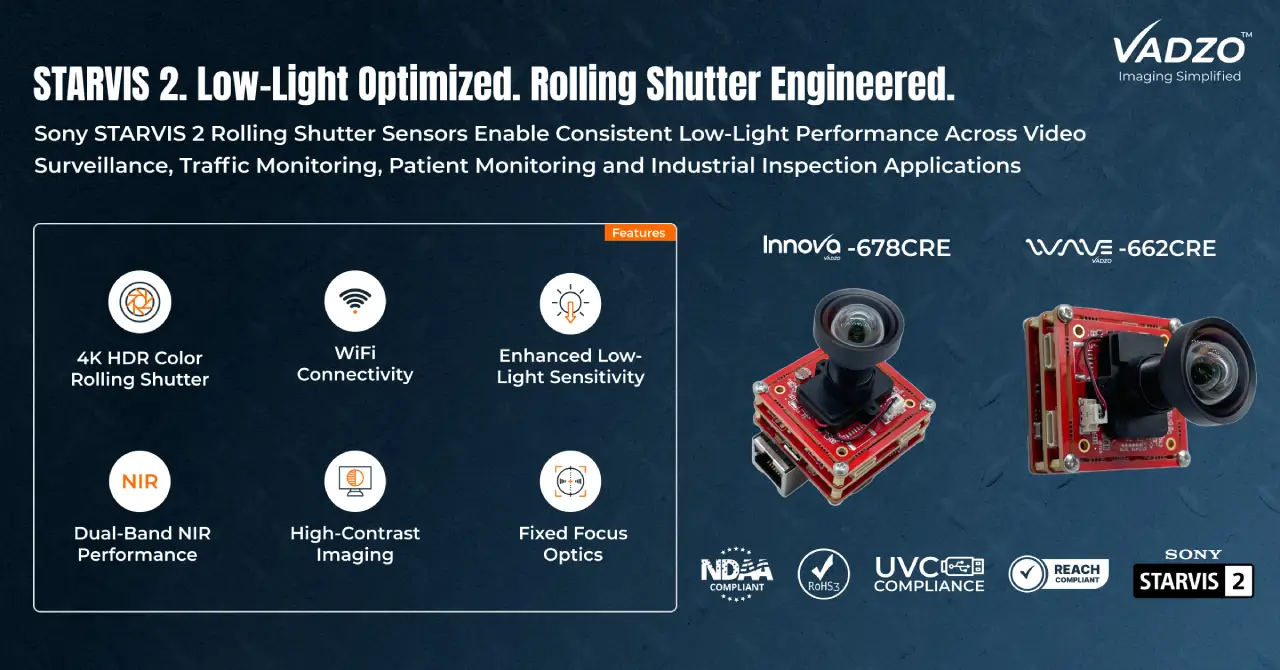
Sony STARVIS 2 Rolling Shutter Sensor Overview
The Sony STARVIS 2 sensor family represents the second generation of Sony's back-illuminated CMOS rolling shutter architecture designed to address the growing demand for low-light sensitivity in surveillance, traffic monitoring, and embedded AI applications. Unlike the first-generation STARVIS lineup, STARVIS 2 sensors incorporate enhanced pixel structures that deliver improved NIR sensitivity at 850 nm and 940 nm, together with higher signal-to-noise ratios under low ambient illumination, making them a strong foundation for the next generation of security camera and industrial low-light camera products.
Rolling shutter architecture in STARVIS 2 sensors reads pixel data row by row rather than exposing the full frame simultaneously. While this differs from global shutter designs, it carries unique advantages in low-light environments: higher fill factor per pixel and extended integration time without the fixed exposure constraints of global shutter sensors. For applications such as fixed-mount surveillance, patient monitoring in ICU environments, digital pathology, and traffic monitoring where subjects or the camera itself are largely stationary, rolling shutter low-light performance surpasses global shutter alternatives at equivalent resolutions.
Vadzo Imaging has built its low-light rolling shutter Sony Starvis camera portfolio around two STARVIS 2 sensors: the Sony IMX678 at 8MP 4K resolution and the Sony IMX662 at 2MP 1080P resolution. Each sensor is matched to an interface suited to its target deployment context. The IMX678 drives the Innova-678CRE 4K HDR 8MP GigE camera for bandwidth-intensive industrial inspection and quality inspection deployments, while the IMX662 drives the Wave-662CRE IMX662 1080P WiFi camera for edge-deployed surveillance, smart parking, and AGV camera applications where cable-free installation is preferred.
Key Specs
Innova-678CRE Sony Starvis Camera: 8MP (3840 x 2160) | Sony IMX678 STARVIS 2 | 4K HDR | IMX678 Color Rolling Shutter | Fixed Focus | NIR Sensitivity (850 nm / 940 nm) | GigE Vision | Windows · Linux
Wave-662CRE Sony Starvis Camera: 2MP (1920 x 1080) | Sony IMX662 STARVIS 2 | 1080P | IMX662 Color Rolling Shutter | Fixed Focus | NIR Sensitivity (850 nm / 940 nm) | WiFi | Windows · Linux · Android
Key Capabilities of the Sony STARVIS 2 Rolling Shutter Camera Series
Low-Light Sensitivity That Matches Real Deployment Conditions: The Sony STARVIS 2 rolling shutter sensor achieves its low-light advantage through back-side illumination, which positions the photodiode layer on the light-receiving side of the silicon, removing metal wiring from the optical path. This maximizes the active pixel area available for photon capture and directly improves quantum efficiency at low photon flux levels. In practical terms, the IMX678 and IMX662 produce clean usable images in environments where alternative sensors introduce significant noise. For a low-light surveillance camera or a traffic monitoring camera operating at night or in tunnels, this architecture removes the need for supplementary lighting infrastructure, reducing deployment cost and system complexity.
NIR Sensitivity for IR-Illuminated Pipelines: Both the IMX678 and IMX662 sensors deliver strong NIR sensitivity at 850 nm and 940 nm, enabling operation under infrared illumination in environments where visible light is limited, excluded, or intentionally controlled. This capability makes the Innova-678CRE and Wave-662CRE relevant to a range of NIR-dependent workflows including vein pattern recognition in patient monitoring, material classification in quality inspection, night-vision in video surveillance camera deployments, and structured NIR illumination in digital pathology. The NIR performance is achieved without degrading sensitivity in the visible spectrum, giving both camera products balanced imaging capability across a wide range of lighting scenarios.
4K HDR Performance for High-Contrast Scenes: The Innova-678CRE 8MP GigE camera leverages the IMX678 sensor's HDR capability to capture detail simultaneously across bright highlights and deep shadow regions in a single frame. This matters in traffic monitoring, outdoor surveillance, and smart parking environments where the scene includes direct sunlight, reflective surfaces, and shadowed areas in the same field of view. HDR operation preserves license plate detail, pedestrian features, and object geometry across the full contrast range without requiring multiple exposure passes or frame blending steps that introduce latency in real-time systems.
GigE Interface for Industrial and Robotics Integration: The Innova-678CRE Sony IMX678 GigE camera connects via GigE Vision, enabling long-distance cable runs and deterministic high-bandwidth image transfer suitable for industrial automation, AGV camera setups, and robotics camera applications where USB bandwidth or cable length constraints make USB-based alternatives impractical. The GigE interface supports GenICam-compliant host integration, allowing the Innova-678CRE to drop into existing GigE-based machine vision pipelines for quality inspection and conveyor-line imaging without proprietary driver stacks.
WiFi Connectivity for Edge-Deployed Surveillance and Monitoring: The Wave-662CRE IMX662 WiFi camera eliminates cabling requirements for network connectivity, making it suitable for smart parking, ICU camera installations, low-light surveillance camera deployments, and any application where running a network cable to the camera position is impractical. The IMX662 sensor's 2MP Sony STARVIS 2 output at 1080P provides sufficient resolution for license plate reading, face detection, and motion-based monitoring over WiFi without the bandwidth overhead of 4K streams in constrained network environments.
Fixed Focus for Reliable Geometry in Static Deployments: Both camera products use fixed-focus optics suited to applications with defined working distances such as overhead parking lot monitoring, ceiling-mounted ICU camera installations, inspection lanes in quality inspection lines, and fixed-mount UAV camera payload integration. Fixed focus eliminates focus drift under temperature cycling and vibration conditions that affect motorized or VCM-based autofocus mechanisms in outdoor and industrial environments, ensuring consistent image geometry across long deployment periods.
Applications
Traffic Monitoring: The IMX678 Color rolling shutter camera at 4K HDR resolution captures lane-level vehicle detail including license plates and vehicle classification under daylight, dusk, and nighttime lighting conditions. The Innova-678CRE 8MP GigE camera integrates with roadside edge computing units via GigE Vision and covers wide intersection fields of view where resolution and low-light sensitivity directly affect detection accuracy.
Video Surveillance and Security: The Wave-662CRE IMX662 WiFi camera delivers low-light surveillance performance without supplementary lighting in perimeter monitoring, corridor surveillance, and indoor security applications. The IMX662 rolling shutter for low-light performance maintains object detail in near-dark conditions where competing sensor designs require IR floodlights.
Patient Monitoring and ICU Imaging: Continuous patient monitoring in ICU environments demands low-light sensitivity that allows imaging under reduced ambient lighting without disturbing patients. The Wave-662CRE IMX662 WiFi camera provides Wi-Fi connectivity for bedside deployment without cabling to nursing stations and delivers consistent image quality across the wide illumination variance found across day-shift and night-shift ICU lighting conditions.
Smart Parking: Overhead camera positions in parking structures require wide field of view coverage and consistent low-light performance across all hours. The Wave-662CRE 2MP WiFi camera installs without network cabling and provides Sony STARVIS 2 low-light sensitivity for occupancy detection, vehicle classification, and license plate recognition across deck-level and underground parking environments.
Digital Pathology: Pathology imaging under NIR-structured illumination and low-light brightfield microscopy settings benefit from the STARVIS 2 sensor architecture. The Innova-678CRE IMX678 Color camera provides 4K resolution for slide scanning and tissue imaging where detail preservation across high-contrast stained and unstained regions determines diagnostic utility.
Quality Inspection: Surface defect detection, dimensional measurement, and inline inspection on production lines require high-resolution, low-noise imaging under controlled factory lighting. The Innova-678CRE 4K HDR 8MP GigE camera delivers consistent color rolling shutter imaging at production-line speeds with GigE Vision integration into GenICam-compliant inspection software used in semiconductor, PCB, and precision manufacturing quality inspection workflows.
AGV and Robotics: Autonomous mobile robots and AGV camera systems operating in warehouse and factory environments encounter mixed lighting conditions including overhead fluorescent, LED, and low-light transition zones. The low-light rolling shutter performance of the STARVIS 2 sensor series reduces the reliance on supplementary lighting on mobile platforms where power budgets are constrained, and the Sony IMX662 WiFi camera eliminates tether constraints in free-ranging robot deployments.
UAV and Aerial Platforms: Payload-constrained UAV camera integrations require compact low-power camera products that deliver reliable low-light imaging for inspection, surveillance and mapping missions conducted at dusk or in low-ambient environments. The fixed-focus design of both the Innova-678CRE and Wave-662CRE eliminates motorized focus mechanism mass and power draw, and the STARVIS 2 sensor architecture delivers NIR sensitivity for IR-illuminated UAV imaging payloads.
Availability
The Innova-678CRE IMX678 4K GigE camera and the Wave-662CRE IMX662 WiFi camera are both available now for evaluation and production orders through Vadzo Imaging. Evaluation kits include the camera product unit, compatible optics, interface cable, and SDK documentation with no minimum order requirement. Contact Vadzo Imaging at support vadzoimaging.com
"First-generation STARVIS is good. STARVIS 2 is a different class. The enhanced pixel structure delivers NIR sensitivity at 850nm and 940nm that works in IR-illuminated pipeline vein recognition, material classification, and night surveillance. And it does this without sacrificing visible spectrum performance. Our customers deploying the Innova-678CRE for traffic monitoring are getting clean license plate reads at dusk without external floodlights. That is the difference between a camera that works and a camera that forces the system to redesign."
Frequently Asked Questions (FAQs)
What makes STARVIS 2 different from the original STARVIS?
STARVIS 2 has a redesigned pixel structure with stronger NIR sensitivity at 850 nm and 940 nm and a better signal-to-noise ratio in dim conditions. In practice, it produces usable images where first-gen STARVIS starts to show significant noise.
When should I choose the Innova-678CRE Gigabit Ethernet Sony Starvis camera over the Wave-662CRE WIFI Starvis Camera?
Choose the Innova-678CRE when you need 4K resolution, HDR, or a wired GigE connection for long cable runs or industrial integration. Choose the Wave-662CRE when 1080p is sufficient and cable-free installation matters more, such as parking structures, bedside ICU mounts, mobile robots.
Where is the Sony IMX662 WiFi camera most effective?
The Sony IMX662 WiFi camera excels in low-light, wireless environments such as indoor surveillance, ICU monitoring, underground parking, and mobile robotics, where reliable imaging is needed without wired infrastructure.
Do these cameras work without IR illuminators?
In very low ambient light, yes, both sensors perform well enough to reduce or eliminate supplementary IR lighting in many deployments. Completely dark environments will still benefit from illumination, but the STARVIS 2 architecture raises the threshold significantly.
Why choose rolling shutter for surveillance applications?
Rolling shutter sensors offer higher light sensitivity compared to global shutter alternatives, making them ideal for low-light, fixed-position monitoring scenarios like traffic systems, security, and smart infrastructure.
About Vadzo Imaging
Vadzo Imaging is a global provider of embedded vision solutions delivering high-performance camera technologies and imaging platforms for robotics, industrial automation, UAVs, edge AI, and medical systems. Its camera portfolio is designed for seamless integration with leading embedded platforms such as NVIDIA Jetson, Raspberry Pi, Qualcomm RB series, and NXP i.MX. Vadzo Imaging supports customers through hardware customization, firmware development, and its VISPA ARC SDK, enabling faster development and deployment of vision-based systems.
Media Contact
Alwin Vincent
Vadzo Imaging
Email: alwin@vadzoimaging.com
LinkedIn: Vadzo Imaging
YouTube: Vadzo Imaging
X: Vadzo Imaging
SOURCE: Vadzo Imaging
View the original press release on ACCESS Newswire